
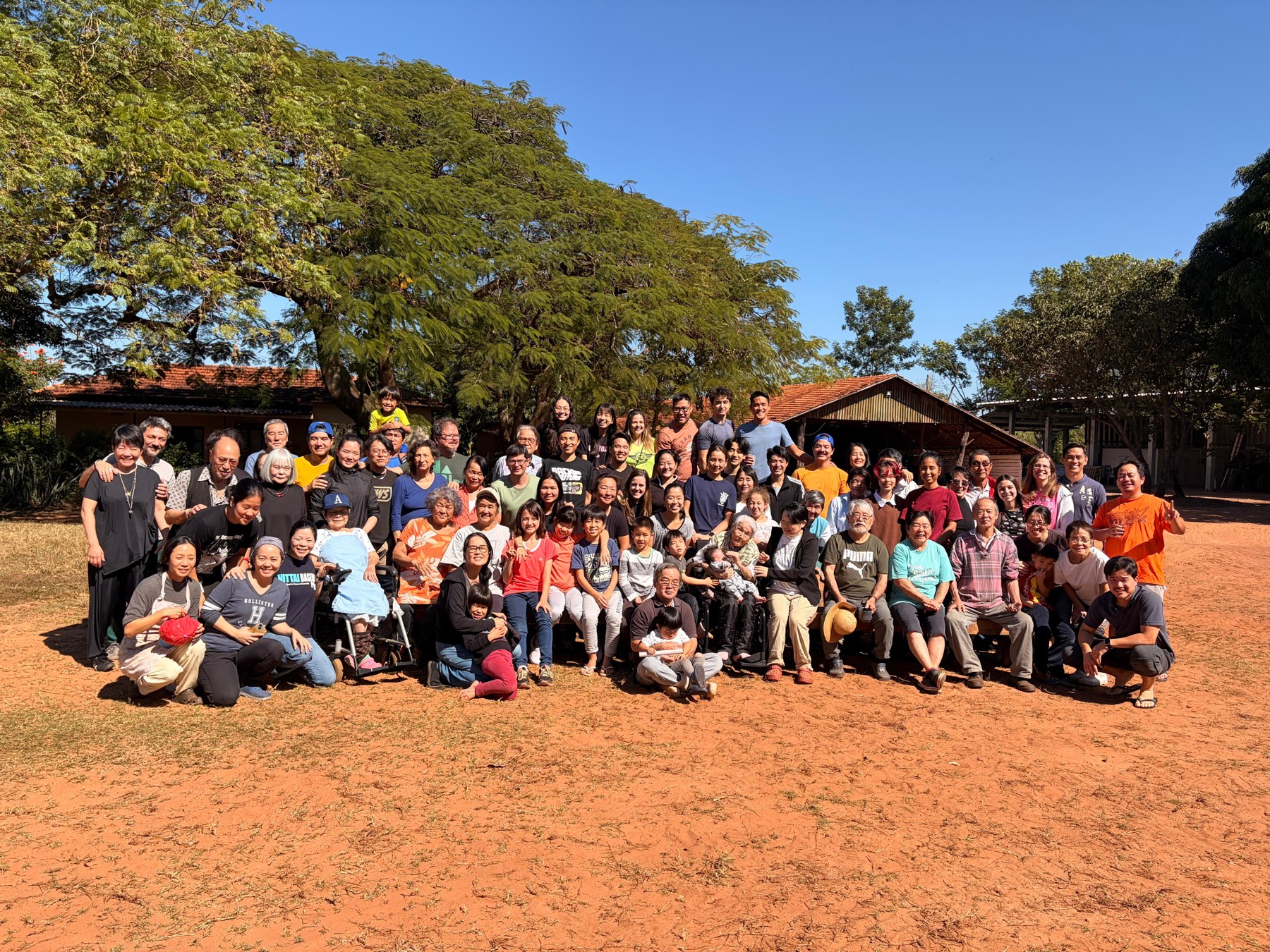
The community gathered under the great tree, in front of the houses: about ninety people of all ages, from the elders seated at the front to babies in arms.

Comunidade Yuba

More than fifty people, four generations, living and working together in the countryside of São Paulo since 1935. We farm, we pray, and we make art.

Primeira Aliança · Mirandópolis · São Paulo · since 1935

#01What is Yuba

What is Comunidade Yuba?

A life in which work, prayer and art are inseparable.

We are more than fifty people, from four generations, living and working together in the countryside of São Paulo since 1935. We farm, we pray and we make art. For ninety years these three things have been inseparable. :)

To make art, to practice one's faith, to work the land. A life in which these three things are in harmony is the essential way of living that human beings seek.

Isamu Yuba, founder

Art is not a third activity alongside work and prayer. It is the way both are done.

Since 1961

The theater

The Yuba Theater was built in one week, in the middle of a coffee field, in December 1961, so there could be a Christmas performance that year. Everyone worked on it, from children to adults.

The stage lights are handmade. The house lights use big pot lids. The curtain winch came from a well from pioneer days. The floor is sand.

Our grandparents learned to create where there were no resources. That is what our art is made of.

Since 1961

The ballet

The Yuba Ballet began when the sculptor Hisao Ohara and the ballerina Akiko Ohara arrived from Tokyo.

There have been more than a thousand performances since, in Brazil and abroad. Today, four generations share the stage.

Open to the public since 1948

Christmas

Every year, on December 25 and 30, we present a year's work at the Yuba Theater: music, ballet and drama.

The year's labor, a sacred occasion and the year's art, all in one night.

Japanese-Brazilian caipira

Life here

Japanese is spoken within the community. Children learn Portuguese when they start school.

About 80% of what we eat here is produced here: rice, vegetables, fruit, meat, bread, cheese — plus miso, shoyu and tofu. We grow guava, mango, okra and shiitake, and sell to the region.

It is a quiet place. Autumn and winter are warm and dry; spring and summer are wetter and cooler.

#02Daily life

What do people do here?

The day here is made of work. None of this is programming for visitors: these are things someone does every day, and whoever is here takes part.

Everyone here has their tasks: the fields, the dining hall, the animals, administration, the archives, Japanese study, the arts. But each person's role is deliberately flexible. Those with several skills use all of them, and when a bigger job comes up, everyone pitches in together.

The same person can be a set designer, a cook, a theater director and a dancer. That is not the exception — it is how the community works. Income is shared, in the spirit of one big family, and goes back into everyone's health, education, culture and leisure.

Where the day happens

Each place has someone responsible for it, and all of them are open to whoever is here.

Vegetable garden and fields

Shiitake, guava, okra, mango and the day's greens. What goes into lunch is picked in the morning, and the surplus goes to the region's markets.

Dining hall

The heart of the community. Beyond meals, it is where the meetings, talks, concerts and celebrations happen.

Miso and shoyu factory

Slow fermentation, in vats that rest for months. Much of what the community sells comes from here.

Ceramics gallery

The pieces made here, and the noborigama kiln, fired from time to time.

Leather and luthier workshop

Leatherwork on one side, string instruments on the other, in the same workshop.

Sewing atelier

Work clothes, mending, and the costumes for the dance and theater performances.

Japanese library

Almost entirely in Japanese, with a large manga collection. It is what keeps the language alive across the generations.

Kitahara Wako Museum

Books and documents on the history of Japanese immigration, the community and the Aliança settlement.

Sculpture garden

Open-air stone sculptures, scattered along the path between the houses.

Baseball field

Community games, and now and then tournaments that bring teams from around the region.

At set times

Almost everything organizes itself. Only three things have a day and a time.

Mondays, Wednesdays and Fridays

Dance and ballet class

From 8:30 to 10 pm, after dinner. This is where the performances the community has given since 1961 come from.

Fridays, from 5 pm

Food fair

In the Primeira Aliança neighborhood, just outside the community. Worth timing your visit for a Friday.

Every day, 8–10 am and 1–5 pm

The store

Miso, preserves and whatever the season brings, all made here. No need to book: just come by during opening hours.

#03The table

What do we eat at Yuba?

Meal times

Four meals a day, served at set times. The community eats together.

  1. Breakfast 6–8 am
  2. Lunch 11 am–12 pm
  3. Afternoon snack 1–3 pm
  4. Dinner 6–7 pm

What's on the table

Home cooking, somewhere between Japanese and Brazilian, with whatever the garden gave that day.

Bread or rice

Breakfast

Bread with butter and jam, eggs, and the usual Japanese options: white rice and pickles.

The calmest meal of the day, before everyone heads to work.

Picked that day

Lunch

Always rice and beans, with a selection of vegetables picked in the garden that same morning.

Varied and healthy. Vegetarians have plenty to choose from.

Dish of the day

Dinner

A different dish every day, depending on the specialty of the team in the kitchen.

Ramen, curry, feijoada, spaghetti, tempura, mapo tofu.

#04Ways to visit

How does visiting work?

Spend the day, stay over, or come work with us. Each one calls for a different arrangement.

Everyone arrives in their own way, and there is room for all of them. Some come for a day, some stay a few days and settle into the rhythm of the house, and some arrive wanting to get their hands in the soil and learn by doing. See which one sounds like you. We'll work out the details afterwards.

No overnight

Spend the day

Subject to availability

Guided visits and school excursions, scheduled according to the community's availability.

A visit usually includes the museum, the library and the workshops, plus whatever is happening in the community that day: the harvest, the ceramics kiln firing, a rehearsal.

Recommended group
6 to 8 people
School excursion
up to 30, chaperones included

Book ahead.

Guest

Stay over

Subject to availability

For short stays. A room in the guest house, with the community's meals included.

The lodging is simple, as suits a farm: single beds, a private bathroom and a fan. No luxury, and nothing missing.

Ages 13 and up
R$150 / day / person
Children 12 and under
R$100 / day

Prices as of January 2026.

Backpackers · WWOOF

Live and learn

Subject to availability

For those who want to learn by doing, joining the rhythm of the countryside alongside people who have done this for decades.

The work follows the season: planting, harvest, care. In exchange, we offer lodging, meals and training.

Lodging
shared, separated by gender
Who we're looking for
backpackers and adventurers

No cost, and no expenses.

How staying over works

What you need to know before writing to ask for a date.

How long to stay

2 days / 1 night for a weekend visit. 7 days / 6 nights for immersion, when the community's routine stops being scenery and becomes daily life together.

How many people

3 to 4 is ideal. We've found it's the number that gets the most out of the community. Bring your friends.

Families

Very welcome. There is space to run, animals to see up close and a garden to pick from — and children usually find the rhythm of this place faster than the adults.

Arrival and departure

There is no front-desk schedule. The room is usually ready by 10 am, and departure is arranged around your trip.

Payment

Cash, Pix, bank transfer or credit card. We have a card machine, which also works for purchases inside the community.

Booking

20% of the total. It is what lets us hold the dates and know how many people to expect.

What the rooms are like

Simple, and made for you to spend little time in them.

In the guest house, 2 to 3 people per room, with single beds made up the day before or the day of your arrival, a private bathroom with shower, and a desk or ceiling fan. Air conditioning we don't have.

There is simply too much to do outside: the garden early in the morning, the workshops, the walk to the fields, the conversation that starts after dinner and has no set end. The room is for sleeping well and waking up wanting to be back outside.

What to bring

The short list of what belongs in your bag. The first line is the essential one.

  • Towels: pillows and bed linen are ours, the towel is yours
  • Insect repellent, a hat and sunscreen
  • A toiletry bag with travel-size shampoo and liquid soap
  • Light clothes that can stand the elements
  • Long-sleeved shirts, for the sun
  • Boots, for rainy days and walks in the brush

This is a farm

Two things that surprise people who have never stayed in the countryside.

Clothes get properly dirty with earth here. Bring clothes that are easy to wash, hard-wearing, and that you won't mind damaging during the stay.

The countryside has more wildlife: plenty of birds and animals, but also insects, flies, mosquitoes, frogs and geckos. With children, the rule is not to explore unaccompanied and not to turn over stones or wood: they are hiding places for snakes and scorpions.

Internet and pets

The two questions we hear most.

Internet
Fast WiFi across the community. For online meetings there is space in the Kitahara Wako Museum and the Library, with fiber optic by cable and satellite as backup. You can work while enjoying the community.
Pets
We don't recommend bringing them. We have free-roaming dogs and cats, we cannot take responsibility for accidents, and there is a risk of fleas and ticks in the fields.
#05When to come

When is the best time to come?

The question isn't really which month. It's whether you want to find the community in its everyday rhythm, or in the middle of a festival.

An ordinary day

It's what we recommend.

No festival and no crowds: the community in its usual rhythm. The garden early in the morning, the workshop in the afternoon, dance rehearsal at night. There is time to talk, to learn to make something with your hands, to not be in a hurry.

It is also when there are more free rooms and more people available to truly host you.

A festival day

More beautiful, more crowded, and the spots go fast.

During Festa Junina, Bon Odori and Christmas the whole community mobilizes and many people come from outside. It is beautiful to see — and it is also when we have the fewest free rooms and the least time to spend with each visitor.

If that is your choice, write well in advance.

The year, month by month

The months without a note are the quietest. They tend to be the best.

Summer
  • January After the 10th
  • February
  • March
Autumn
  • April
  • May
  • June
Winter
  • July Festa Junina and school holidays
  • August
  • September Bon Odori
Spring
  • October
  • November Theater and dance rehearsals
  • December Christmas · until the 16th

What has a date

Comes back every year, at about the same time.

Festa Junina
almost always in July, together with the school holidays
Bon Odori
September
Christmas and New Year
December, the big performance of the year

What changes from year to year

Worth asking about when choosing your date.

The baseball tournaments have no fixed date: the calendar changes each season, and sometimes the game happens right here, on the community's field.

The region also has its own calendar, with rodeos and town festivals throughout the year. If you'd like to pair your visit with one of these, ask us.

#06Getting here

How do I get there?

Primeira Aliança neighborhood, in Mirandópolis, 600 km from São Paulo. Four routes, each for a different kind of trip.

We are 600 km from São Paulo, in the countryside. The map helps make the real distance clear.

The full address, for GPS, ride apps or mail.

Associação Comunidade Yuba · Acesso Chikazo Kitahara, km 4,6 — s/n
Bairro Primeira Aliança · CEP 16830-899 · Mirandópolis — SP, Brazil

No one arrives directly at the community. From Mirandópolis it is a few more kilometers of road, and we have a partnership with a taxi driver for that stretch.

Local taxi

Eliseu

R$80 per ride

We partner with Eliseu, who covers the stretch between the Mirandópolis bus station and the community. Especially good for groups: the price is per ride, not per person.

Phone
+55 18 99179-0510
Pick-up / drop-off
Yuba or the bus station

Price as of January 2026.

The four routes, side by side

Four ways to get here, compared by cost, duration and type of trip. Pick the row that looks like yours.

HowApproximate costDurationBest for
Plane + taxiairfare + R$3001h from the airportother states, abroad
CarR$200/person in a group of 57–8hfamilies and groups
BuserR$170/person~11hbackpackers, solo travel
Reunidas PaulistaR$280/person~11hmore luggage, more comfort

Prices as of January 2026.

The schedules, boarding points, phone numbers and apps for each option.

Plane

Araçatuba + taxi

The nearest airport is Araçatuba, 1h from Yuba. We partner with a taxi driver who picks you up at the airport and brings you to the community.

Hugo — taxi driver
+55 18 99618 8989
Price
R$300 per ride
Car

From São Paulo, 600 km

For families and groups of 4 to 5 who want comfort and freedom on the trip.

Route
SP-300 › BR-267 › Marechal Rondon
Tolls
R$150 out + R$150 back
Fuel
R$360 out + R$360 back, with gasoline at R$6.00 and a car doing 10 km/L
On the road
+ R$50 per person for food
Bus · Buser

The cheapest

Boarding is not the most organized, since it is charter-style transport; getting off is easy. The app charges a fee for extra bags.

Departure
9 pm, Barra Funda, São Paulo
Arrival
6:30 am, Petrobras gas station at the entrance to Mirandópolis
Bus · Reunidas Paulista

The official bus-station line

More expensive, but it is the official service to the Mirandópolis bus station. For those who want more peace of mind and carry more luggage.

Departure
8 pm, Barra Funda, São Paulo
Arrival
5 am, Mirandópolis bus station
#07Booking

I want to visit. Now what?

Start with the quick question: it works for anything, and we'll point the way. If you already know what you want, pick your intention below — each has a page of its own.

Each way of being here calls for a different arrangement, and so for different questions. If you just have a question, you shouldn't have to fill in dates and documents; if you're sleeping here, we need to know how many beds to prepare.

None of these requests is a commitment: we reply to work out the details.

Already know how you'd like to come? Pick the form below that fits your intention — each asks only what it needs to.
01 Just a question

You don't need to know yet whether you're coming, or when. Just ask.

First contact

Replies might take a few days to a week, depending on how busy we are.

#08Contact

Who do I talk to?

Fill in the booking form or write an email. We route it to the right person here. You don't need to know who to ask for.

For visits, the form is the fastest path: it already carries the dates and the number of people, which is what we need to reply in one go. For everything else, write to contato@comunidadeyuba.org. We are a small community and we read everything; replies usually go out within a few days.

In the subject line, write your name + the topic. That way the message lands directly with whoever handles it.

Subject Maria Silva + Lodging
Subject João Tanaka + Visits and Tours

Issamu Yazaki

President · Government
Portuguese · English · 日本語

Daigo Yuba

Treasurer
Portuguese · English · 日本語

Hitomi Yuba

Lodging · Visits from Japan
日本語 · Japanese

Rafael Nepô

Cultural Director · Visits and Tours
Portuguese · English